Are Traditional Meridians and Acupuncture Points Being Challenged?
Journalist, International Association for Natural Health: Ai Xiaoxin (November 23, 2025)
An orthopedic surgeon trained at a university of traditional Chinese medicine arrived in France to work in an acupuncture clinic. He believed that the acupuncture techniques he had studied for many years — those familiar meridians and points — would shine abroad. But he was quickly disappointed: he discovered that the traditional acupuncture he had mastered did not produce the ideal results he had expected in treating pain. Faced with patients seeking help, he often felt a sense of guilt.
One day, by chance, a friend introduced him to Tung’s acupuncture — a technique connected to the traditional meridian system but also noticeably different. To his great delight, the effectiveness of the Tung method was indeed far superior to that obtained using the classical points, and some points even produced astonishing results for certain types of pain. However, the number of points capable of achieving such spectacular results was ultimately too small to address the endless variety of pain encountered in clinical practice.
He then turned to Tan’s “instant balancing method” and to Wang Wen-Yuan’s balancing method. Their results were slightly better than those of the Tung method, but the same frustration remained: the efficiency was still not high enough, the speed of action too slow, and the simplicity still lacking. He felt strongly that the real answer must lie elsewhere. Until one day, a chance experience completely changed his understanding of pain and revealed to him some of the body’s unsuspected phenomena.
Thanks to the morphological observational skills unique to orthopedic surgeons, he suddenly realized that different parts of the body had extremely subtle relationships of correspondence — not lines drawn on meridian charts, but “three-dimensional image relationships” between bodily shapes. When combined, these relationships formed a complete and instantly readable system. He called it the “Cross-Body Correspondence System,” abbreviated as the 3C system.
But what truly amazed him was not the name, but the clinical results obtained with the 3C system, which is highly responsive to both massage and acupuncture. Thus was born the 3C technique:
An analgesic effect far superior to that of all acupuncture techniques he had learned;
Without any prior knowledge of meridians or points, the practitioner can very quickly locate the point or area corresponding to the pain; patients often ask, “How do you know it hurts here?”
No needling or massage on the painful area itself: the pain disappears more quickly, without needle manipulation, and with simpler procedures;
Effective not only for common pains but also for mysterious, long-standing pains resistant to all treatments for years — often relieved or eliminated within seconds or minutes;
Because of the precision in locating active points, some pains may seem to “move” during treatment; the 3C technique can chase and treat this fleeing pain until it disappears completely — a first in the history of acupuncture.
The sentence patients repeat most often is: “It’s a miracle! !”
This orthopedic surgeon, always seeking progress and unwilling to settle for traditional methods or existing results, is none other than Zhu Weimin, former orthopedic surgeon at the Xi’an Red Cross Hospital. He came to France for advanced training in 1995. He now works at the Annecy-Geneva Hospital Center as an orthopedic surgeon and is also a registered acupuncturist in Switzerland. The person who advised him to study Tung’s acupuncture was the practitioner of Chinese medicine Yang Yibin, from Lyon.
According to Dr. Zhu, the 3C technique is “The Great Way is extremely simple.” It does not rely on traditional meridians or points, yet its effectiveness far surpasses that of many classical acupuncture methods. This raises certain questions:
Is this a challenge to the traditional meridian theory? Does it imply that the meridian theory is not sufficiently scientific?
Dr. Zhu offers two answers:
The value of the meridian system cannot be judged solely by its analgesic effect. The 3C technique focuses mainly on pain relief, whereas the meridian system has, for thousands of years, explained human physiology, pathology, and the circulation of yin-yang and qi-blood. One cannot deny the scientific relevance of the meridians simply because the 3C technique relieves pain more effectively.
The 3C technique does not depart from the core philosophical essence of the meridian system. The soul of the meridian theory is: “There are meridians everywhere; any place may become a point.” The 3C technique confirms exactly this principle: any area of the body can become a “point” if its correspondence with the disorder is accurate.
Thus, another question arises: If the core principle is the same, why does abandoning traditional meridians and points lead to even better pain-relieving results?
Dr. Zhu provides a particularly profound explanation: “For thousands of years, clinicians have never fully understood the true meaning of the principles ‘Treat the left through the right, the right through the left’ and ‘Treat the upper body through the lower, the lower through the upper.’ When you truly grasp the depth of these ancient sayings, you naturally discover that pain relief can be remarkable. What the 3C technique does is simply add a small refinement to these ancestral principles: ‘body correspondence.’ This is my only contribution. Everything else was already taught by our ancestors—only the ancient books did not explain it in such detail. Through continuous clinical exploration, I finally understood the real meaning of these words.”
Today, this new technique has helped cure many cases of difficult-to-treat pain: a woman with chest pain who had been hospitalized long-term with all examinations normal and who found no relief after ten acupuncture sessions;
a woman suffering from vulvar pain for five years, undiagnosed and untreated in Western medicine; a patient with seven years of post-surgical scar pain; a man hospitalized long-term with persistent intestinal pain; and a patient suffering from back pain for thirty years, having sought help throughout France and Switzerland without success — among other cases.
On September 21, 2025, at the International Acupuncture Congress held in Stockholm, Sweden, the 3C technique was officially presented. Acupuncturists and massage practitioners from more than twenty countries and regions gave it high praise, considering that its dissemination could significantly improve the overall clinical effectiveness of acupuncture in pain treatment. Many experts believe that this technique will bring major changes to the future of pain management.
They warmly praised the generosity of its creator, who freely shares the results of many years of research with doctors and patients around the world, helping more people free themselves from pain. Over the years, after clinical verification by several experienced practitioners — notably Dr. Yang Yibin in France and Dr. Sun Yuxia in Canada — and subsequently, after the Stockholm international conference, by physicians from many countries, the feedback shared in the WeChat group “3C 2025 Sweden” speaks for itself. Source: https://santemtc.com/3c-temoin
You might also be interested in the article below :
American scientific research: Meditation can rejuvenate your brain cells by 20 years
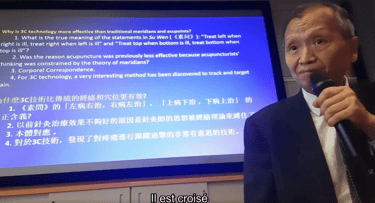
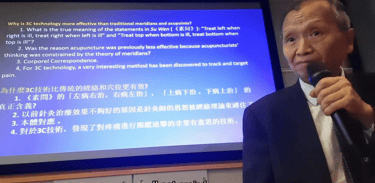
Dr. Zhu Weimin presents the 3C technique at the 2025 International Acupuncture Congress in Stockholm.
Inscrivez-vous à notre newsletter :
Association Internationale de Santé Naturelle
11 Chemin de la Muraz
74520 Vulbens
contact@santemtc.com